

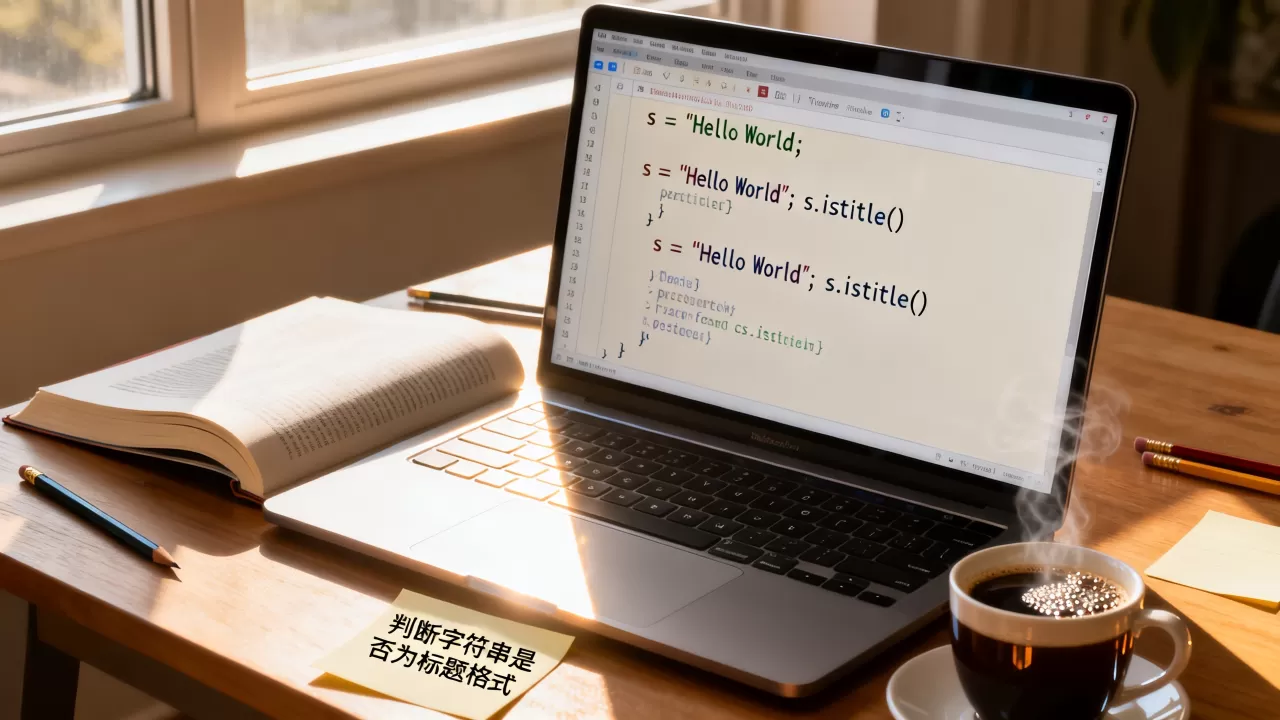
在 Python 中,istitle() 是字符串(str)的一个内置方法,用于检查字符串是否符合“标题格式”(Title Case)。
基本定义
str.istitle() 返回 True

- 字符串中每个“单词”的第一个字母是大写的。
- 字符串中每个“单词”的其余字母都是小写的。
- 字符串中至少有一个字符(即不能是空字符串或全非字母字符)。
否则,返回 False。
注意:这里的“单词”是由非字母字符(如空格、标点、数字等)分隔的连续字母序列。
语法
string.istitle()
- 参数:无。
- 返回值:布尔值(
True或False)。
示例代码
✅ 返回 True 的情况
print("Hello World".istitle())       # True: H大写, e小写; W大写, o小写
print("Python Is Great".istitle())   # True: 每个单词首字母大写,其余小写
print("A".istitle())                 # True: 单个字符,大写
print("It's A Test".istitle())       # True: 撇号被视为分隔符,"It"、"A"、"Test" 都符合标题格式

❌ 返回 False 的情况
print("hello world".istitle())       # False: 所有字母都是小写
print("HELLO WORLD".istitle())       # False: 所有字母都是大写
print("Hello world".istitle())       # False: "world" 的首字母是小写
print("Hello123".istitle())          # False: "123" 不是字母,但 "Hello" 后没有新单词开始,整体视为一个单词,但 "123" 不影响判断?
# "Hello123" 被视为一个单词 "Hello123",首字母 H 大写,其余 e,l,l,o 小写,1,2,3 是非字母字符,不参与大小写判断。
# "Hello123".istitle() 返回 True!
print("Hello123".istitle())          # True
print("Hello World!".istitle())      # True: 标点符号不影响
print("123".istitle())               # False: 没有字母字符,不满足“至少有一个字母”的条件
print("".istitle())                  # False: 空字符串
print("   ".istitle())               # False: 只有空格,没有字母
常见误区与注意事项
🔹 与非字母字符的关系)` 只关心字母字符的大小写,数字、标点符号、空格等被视为单词分隔符或忽略大小写判断。
print("Hello-World".istitle())       # True: "Hello" 和 "World" 都符合标题格式
print("Hello_world".istitle())       # True: 下划线被视为分隔符
print("Hello123World".istitle())     # False: "123" 不是分隔符,所以整个 "Hello123World" 是一个单词,但 "W" 是大写,而它前面是数字,Python 将其视为一个单词,首字母 H 大写,但 "W" 在中间且大写,不符合“其余字母小写”的规则。
🔹 与 title() 方法的区别)是将字符串转换为标题格式。) 是检查字符串是否已经是标题格式。
text = "hello world"
print(text.title())      # "Hello World"
print(text.istitle())    # False
text2 = "Hello World"
print(text2.title())     # "Hello World"
print(text2.istitle())   # True
🔹 与 isupper() / islower() 的区别
isupper():所有字母都是大写。islower():所有字母都是小写。)`:每个单词首字母大写,其余小写。
print("HELLO".isupper())       # True
print("hello".islower())       # True
print("Hello".istitle())       # True

实际应用示例
验证用户输入的标题是否规范
def check_title_format(title):
    if title.istitle():
        print(f"'{title}' 是有效的标题格式。")
    else:
        print(f"'{title}' 不是有效的标题格式。")
check_title_format("Python Programming")  # 有效
check_title_format("python programming")  # 无效
check_title_format("Python programming")  # 无效
过滤不符合标题格式的字符串
valid_titles = [t for t in titles if t.istitle()]
print(valid_titles)  # ['Hello World', 'Python Is Fun']
| 方法 | 用途 | 示例 |
|——|——|——|)| 检查字符串是否为标题格式 |“Hello World”.istitle()True | 将字符串转换为标题格式 | "hello world".title() → "Hello World" |
| isupper() | 检查所有字母是否为大写 | "HELLO".isupper() → True |
| islower() | 检查所有字母是否为小写 | "hello".islower() → True |
)` 是一个非常有用的方法,用于验证文本是否符合标题格式,尤其在处理用户输入或生成标题时非常有用。
首发原创文章,作者:王坚,如若转载,请注明出处:https://idctop.com/article/477655.html